
Missing Shoes
The Big Restack of AI as Strategic Imperative

Some weeks compress scale and simplicity into the same frame. On one hand, there are conversations about national capability, infrastructure, capital flows, and the future of work. On the other, there are small, human reminders that planning has limits, muscle memory matters, and friendships quietly sustain ambition.
What stays with me is the contrast — and the chance encounters in between. Bumping into old friends in unexpected corridors, running into former students navigating their own new journeys, exchanging quick updates that somehow carry years within them. Serendipity has a way of stitching together chapters we think are separate.


So, I arrived ready for the future — agenda in place, sessions marked in calendar — only to realise I had forgotten my running shoes. It felt oddly symbolic. In our rush to build AI infrastructure, we may perfect the architecture yet miss the essentials. Fortunately, it is the human layer that still gets us to the start line.
Read further to know more.
DTW
During the Week, I attended the India AI Impact Summit 2026 at Bharat Mandapam in New Delhi. The scale was impressive — heads of government, global CEOs, multilateral institutions, startup founders, GPU announcements, semiconductor coalitions, and over 70 countries signing the New Delhi declaration.
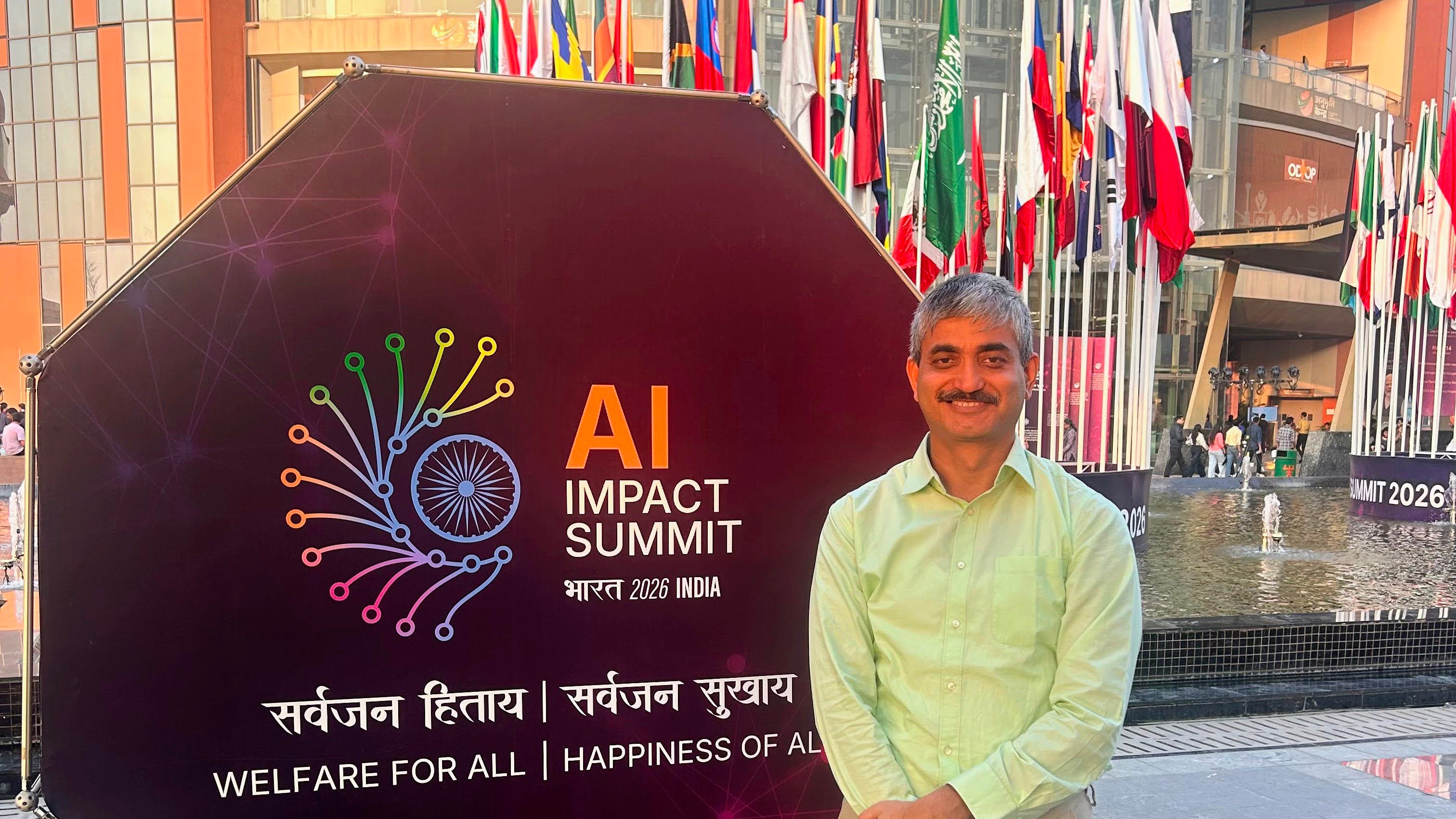
I felt that it was not just a technology summit as AI was no longer discussed as a digital efficiency tool. It was framed as infrastructure, sovereignty, labour policy, energy planning, capital allocation, and global positioning. The language had shifted from “adoption” to “architecture.”
If one theme cut across the plenaries and the smaller sessions I attended — from Bhashini’s voice ecosystem launch to discussions on population-scale AI infrastructure and Global South AI safety — it was that AI is not a technology upgrade. It is a strategic imperative. so let us examine this through the four lenses of the Big Restack — and add a fifth: the Human in the AI Stack.
1. Complement Shift — From Enterprise Efficiency to National Capability
For the last decade, AI complemented enterprise digitisation. It automated workflows, improved analytics, optimised logistics, and enhanced customer experience but mostly sat within departments but at the Summit, the complement shifted decisively.
AI is now being seen paired with:
Sovereign compute capacity (an additional 20,000 GPUs announced over an existing 38,000)
Semiconductor supply chain alliances (India joining Pax Silica)
State-level quantum and AI infrastructure (for example, seven MoUs signed by Andhra Pradesh)
Energy-resilient data centres
Digital Public Infrastructure as shared rails
AI is no longer a complement to business process. It is a complement to national capability. For example, I interpreted the launch of the Policy Report and Developers’ Toolkit for Building an Open and Responsible Voice Technology Ecosystem in India at the Bhashini Pavilion as an important shift. Voice is not a feature in India, it should be seen as an access infrastructure for billions of time-literrate across hundreds of dialects thereby signalling a restack: from enterprise AI to nation-scale AI.
2. Architecture — From Pilots to Population-Scale Systems
Earlier AI discourse was pilot-driven limited to Proof-of-concepts, Sandbox innovation and Isolated use cases but this Summit signalled architectural maturity. The session on Building Population-Scale Digital Public Infrastructure for AI reframed AI as shared rails rather than proprietary silos focusing on shared compute clusters, federated data exchanges, interoperable APIs and most important Public-private co-creation.
India’s success with Aadhaar and UPI is now being extended into AI design thinking. Infrastructure must reduce entry barriers for startups, MSMEs, and researchers because without shared rails, AI may remain capital-concentrated.
3. Tempos — Acceleration, Anxiety, and Geopolitics
The tempo at the Summit was unmistakably political.
IMF research suggests AI could lift global growth by 0.8%. At the same time, OECD estimates indicate that 27% of employment sits at high risk of automation. Simultaneously, protests erupted inside the venue — reflecting youth anxieties about employment, trade agreements, and sovereignty.
AI is unfolding at three speeds:
Infrastructure speed — GPUs, data centres, energy.
Capital speed — venture flows, state investments, global coalitions, MoUs
Social speed — labour anxiety, governance debates, sovereignty concerns.
The launch of the Global South Network on AI Safety & Evaluations reinforced that safety is not speculative existential risk alone. It is contextual deployment risk — bias in datasets, fragile institutional capacity, public system constraints.
Strategic imperative requires synchronising these tempos as competitiveness erodes if we move too slowly but we move too fast and risk fracturing social legitimacy.
4. Constraint — Talent, Trust, Energy
The constraint shifts from algorithmic capability to system readiness. Every restack exposes a binding constraint and following three emerged clearly.
First,Talent; AI literacy cannot be episodic. We need modular, continuous, context-aware training for all the stakeholders. De-skilling risk is real if professionals outsource judgement to algorithms. This is specially true for younger adults who might be missing the steady hand holding offered during internships and apprenticeship.
Second, Trust; Open data must coexist with privacy safeguards. For example, Farmers’ data must empower, not exploit them sending random, untrustworthy and useless updates.
Finally, Energy. Compute requires power as the AI infrastructure is energy-intensive and Data centre expansion demands grid resilience and renewable alignment.
5. The Human in the Stack — Where Do We Sit?
One layer often missing in AI architecture diagrams is the human layer. So, the natural questions to ask is- Where do Indians sit in the AI value chain? Today, we are strong in application development, deployment engineering, DPI orchestration, and multilingual adaptation. We are less dominant in foundational model training, semiconductor fabrication, and energy-intensive compute ownership. This creates strategic choices around capital allocation, infrastructure build-out, and workforce design.
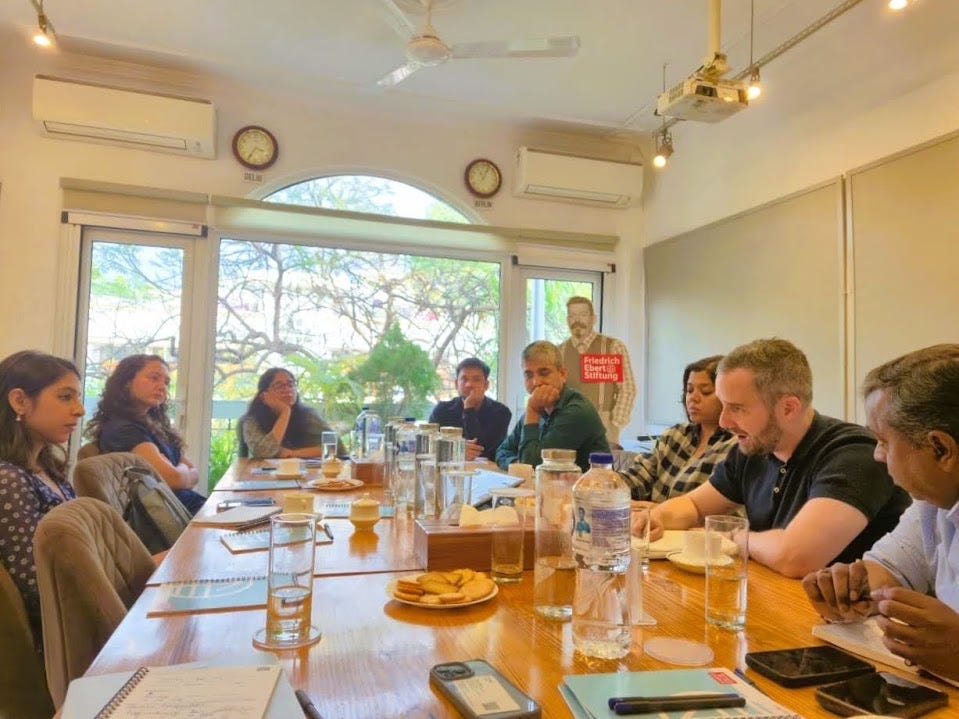
At a brainstorming session hosted by FES India on equitable digital futures, the conversation centred on one question: how do we ensure AI widens participation rather than concentrates power? Because, AI infrastructure without human capability architecture risks deepening divides. The real stack is not just compute and data — it is skills, mobility, judgement, and institutional readiness.
OTW
Over the Weekend, I found myself at the start line of the New Delhi Marathon almost as an afterthought. Though it almost didn’t happen. I landed in Delhi for the AI Impact Summit feeling well-prepared, only to be reminded (thanks to an SMS about my bib number) that I had packed well but forgotten about the marathon that I signed up months ago and hence no running shoes. A quick rescue operation by Archana and friends in Hyderabad ensured my race kit arrived in time. Human networks still outperform any algorithm.
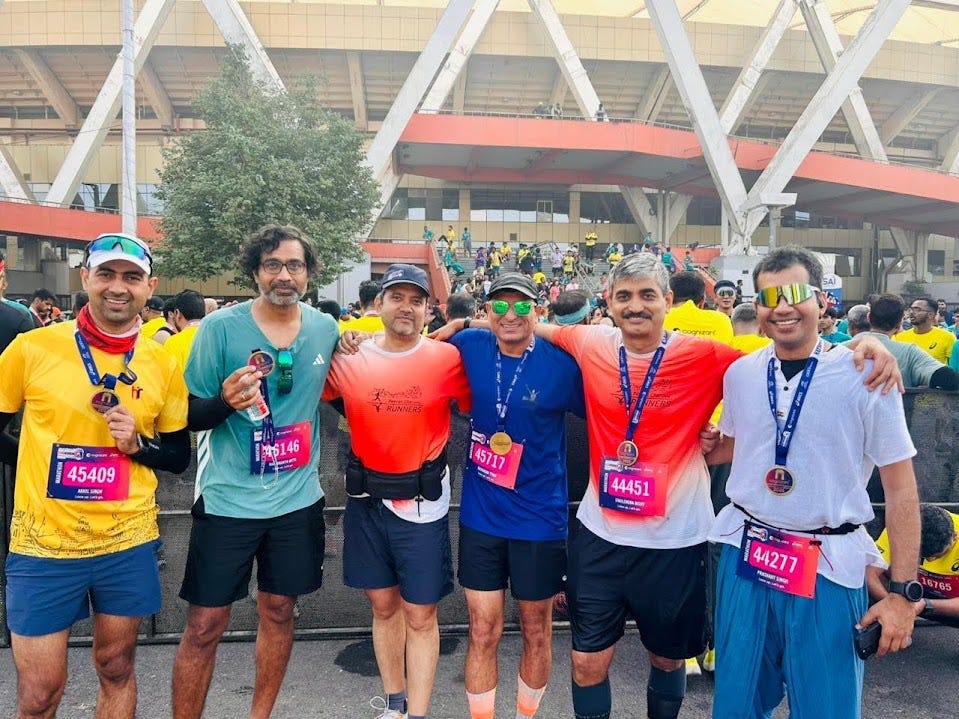
The marathon itself was less about performance and more about rhythm. No chasing splits, no dramatic targets — just steady pacing through Delhi’s crisp winter morning as runners briefly claimed the roads before the city awoke. After a week immersed in conversations about AI infrastructure and strategic scale, the simplicity of distance running felt grounding. And perhaps that is the larger lesson. In seasons of intellectual acceleration — AI summits, policy debates, venture labs — it is grounding to return to something elemental. Left foot. Right foot. Breath. Repeat

Muscle memory carries us forward long after motivation fluctuates. The plan was simple: treat the first 20 miles like a disciplined Sunday long run — steady, conversational, controlled — and then let the final 10 kilometres feel like an event. Because not every run needs to be extraordinary, some simply remind you that endurance — in sport or strategy — is built quietly, one disciplined step at a time.
I Love You
Shailendra
PS
We are launching the CeDT AI-Embedded Digital Venture Lab this June 2026 as a semester-long venture studio where student teams will build AI-augmented SaaS and platform solutions across sectors such as health, education, skilling, MSMEs, agriculture, climate, energy, and informal labour markets. These are not slide-based projects; each team will deliver a working MVP with embedded AI workflows, automation logic, dashboards, and governance safeguards.
We are inviting alumni and industry leaders to join us as Virtual Board Advisors and sector mentors. Your role would be to engage strategically at defined checkpoints—challenging the venture thesis, stress-testing architecture decisions, questioning AI integration choices, and pushing teams on scalability, defensibility, and responsible design. The time commitment is modest (approximately four hours across the semester), but the influence is significant.
We are particularly keen to work with professionals who bring lived experience in building or scaling digital products, managing platform ecosystems, integrating AI into decision workflows, designing analytics dashboards, or navigating regulatory and compliance environments. Domain expertise in areas such as HealthTech, AgriTech, ClimateTech, MSME commerce, skilling platforms, fintech, or labour marketplaces would add invaluable depth. Just as importantly, we value those who understand how incentives, governance structures, and data ownership shape real-world outcomes.
This Lab is designed as a bridge between institutional learning and market reality. By participating, you will not only mentor student ventures but also contribute to shaping how future managers think about AI, platforms, and equitable digital transformation. If you are willing to invest your perspective in building responsible, scalable digital enterprises, we would be delighted to collaborate.
Just reply to this email or drop a comment below!
AI-augmented SaaS and platform solutions across sectors - this sounds so cool! Looking forward to it sir
Inspiring